Courier and parcel scams: nobody from customs is calling you
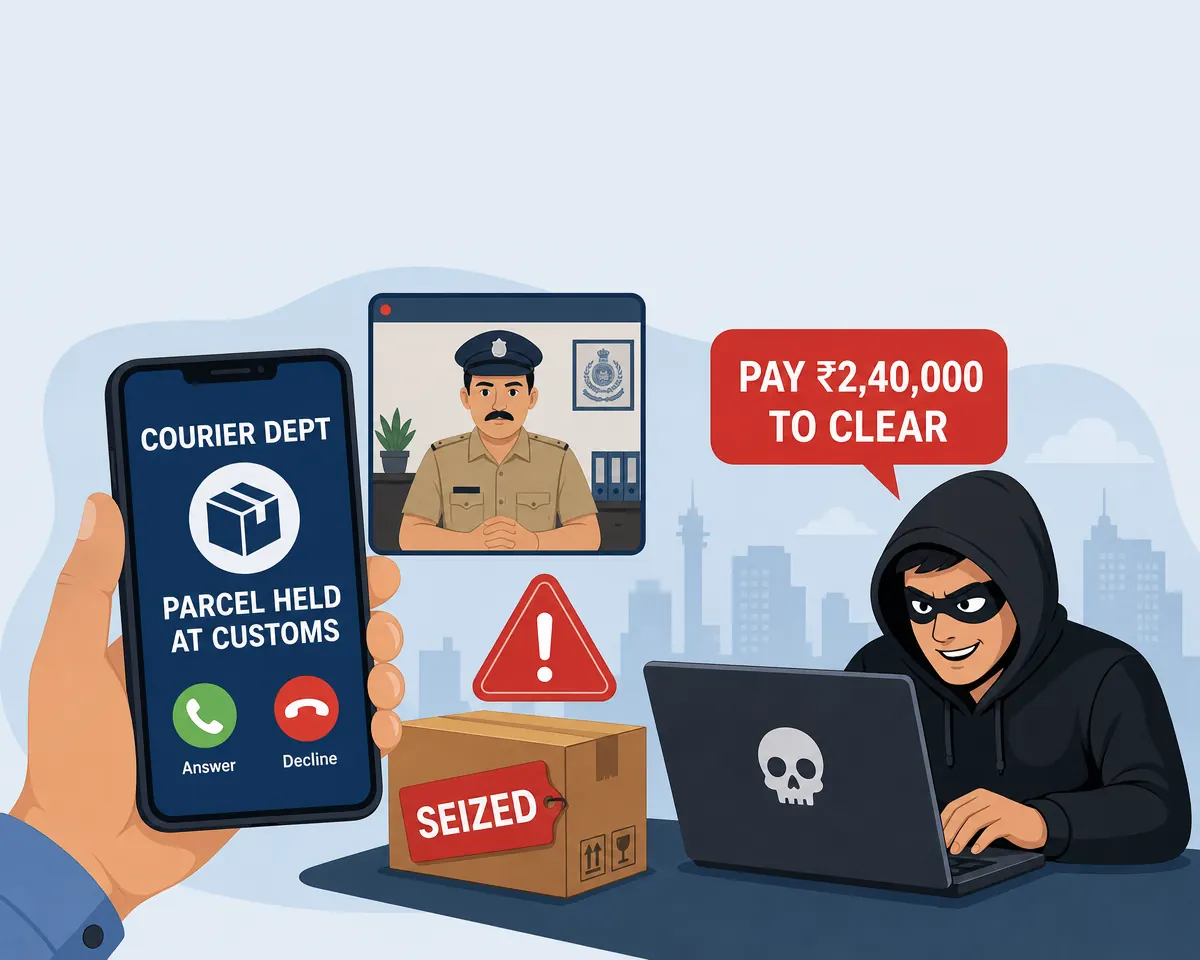
No courier company and no customs officer in India telephones you about a parcel that contains drugs, and none of them takes a payment over a call to make a case go away. A real seized consignment produces a written notice from Customs; a real delivery problem shows up when you type the tracking number into the courier's own website. A call, a WhatsApp message or a link that asks for money first is the scam, whatever name is on it.
How it plays out
The gift from a friend abroad that was stuck at customs
She has been talking for two months to a man who says he is a surgeon working in the UK. He is attentive and never asks for anything. Then he says he has sent her a gift for her birthday: a phone, some jewellery, and, because he trusts her, some cash he wants her to keep safe for a visit.
The next morning a woman calls from "Mumbai airport customs". The parcel has arrived, the customs duty is ₹38,000, and it must be paid today to the account she will send on WhatsApp, or the parcel is returned. The caller has the sender's name, the contents, and a parcel number. She pays.
By evening there is a second call. The parcel was scanned, foreign currency was found inside, and that is a money-laundering matter unless an anti-laundering certificate is obtained: ₹1,20,000, refundable with the parcel. The surgeon, when she messages him, is distraught and begs her to pay; he will return every rupee when he lands.
There was no parcel, no customs officer, and no surgeon. The profile, the gift and the officer were one operation, and the certificate was the fourth payment it had planned before the first message was ever sent.
₹1,58,000 across two payments in one day, for a parcel that never existed.
A composite of the courier and customs-parcel patterns as described in Indian police advisories, courier companies' own fraud warnings and reported cases, including the gift-parcel variant that follows an online friendship. No real person, company or case is depicted; the amounts are illustrative.
Where it could have stopped
The customs duty being payable to a bank account over WhatsApp. Customs duty is assessed and paid through the courier or the Customs portal against a written notice, never into an individual's account on a caller's instruction. The moment the officer sent an account number, the officer was the scam.
 High risk
What EnfoldAI does here
Scam SMS filter
The parcel notice and the payment instruction arrive as SMS or WhatsApp messages. EnfoldAI flags the courier and customs SMS as a scam in the inbox, and anything that arrives on WhatsApp can be pasted into the checker before the "duty" is paid.
Flags scam and spam SMS automatically.
Auto-check with EnfoldAIHow this scam works
The order is the explanation. Find where your own experience stops in this list. That is how far along the script has run.
- The common version opens with a call, often automated, from a "courier company": a parcel in your name, usually going abroad, has been intercepted with drugs, passports or cash inside. Press a key to speak to an executive, who reads out a tracking number and your own details.
- The executive "transfers" you to the police, the Narcotics Control Bureau or a cyber cell. From here it is the digital arrest script: a video call, a uniform, a case number, an instruction not to tell anyone, and a demand to move your money to a "verification" account. The digital arrest page describes the rest.
- The gift version follows an online friendship. Someone abroad sends you a present; "customs" calls about the duty; then cash or gold is "found" inside and a laundering certificate, a tax or a penalty must be paid to release it. Every payment reveals a new one.
- The delivery-fee version is an SMS or WhatsApp message: your parcel could not be delivered, pay ₹25 or ₹49 to reschedule, with a link. The page asks for your card number, expiry, CVV and the OTP that follows, and the "fee" is the whole card limit.
- Some versions skip the call: a message says your consignment is held at customs, with a link to pay duty, and the link downloads an APK named after the courier. That app reads the OTPs that arrive afterwards.
- All of them borrow a real company's name. The couriers whose names are used have said publicly that they do not call about seized parcels or ask for payment or personal details on an unsolicited call.
If it has already happened
In order, and the order matters. The first step is the one that can still get the money held, so it comes before everything else.
- If you are still on the call, end it. Nothing lawful is lost by hanging up, and a real notice from Customs would arrive in writing.
- If you paid, call your bank on the number on your debit card and ask it to raise a fraud dispute and hold the beneficiary; if card details went into a link, ask for the card to be blocked and reissued.
- Report on 1930 or at cybercrime.gov.in as soon as you can, with the numbers that called, the account you paid into, and screenshots of the messages.
- If the link downloaded a file, uninstall it, change the passwords and PINs of every account that sends OTPs to that phone, and treat any transaction since as suspect.
- Check the parcel, if there ever was one, by typing the courier's website address yourself and entering the tracking number there. Do not use a link or a number from the message.
- Expect a follow-up call offering to recover the money for a fee. It is the same list being worked a second time.
Courier and parcel scams: common questions
The questions people actually ask about this one, answered in a line or two each.
Does customs or a courier company ever call about a parcel containing drugs?
The customs duty on a gift was asked for by UPI. Is that how duty is paid?
I paid a ₹25 re-delivery fee through a link. What happens now?
Who do I report a fake courier call to?
Check before you trust
Paste any SMS, link or app and get a verdict before money moves. Auto-scan flags scam messages the moment they arrive.
Suspicious message? Check it free →