Prepaid task scam: the first payment is the bait
No real job asks you to pay in order to be paid. In a task scam the early payouts are real and small, and they exist to make the later deposits feel safe. The moment work requires a deposit, a registration fee, a "training kit" or a security amount, it is not work, and no further payment will release what you have already put in.
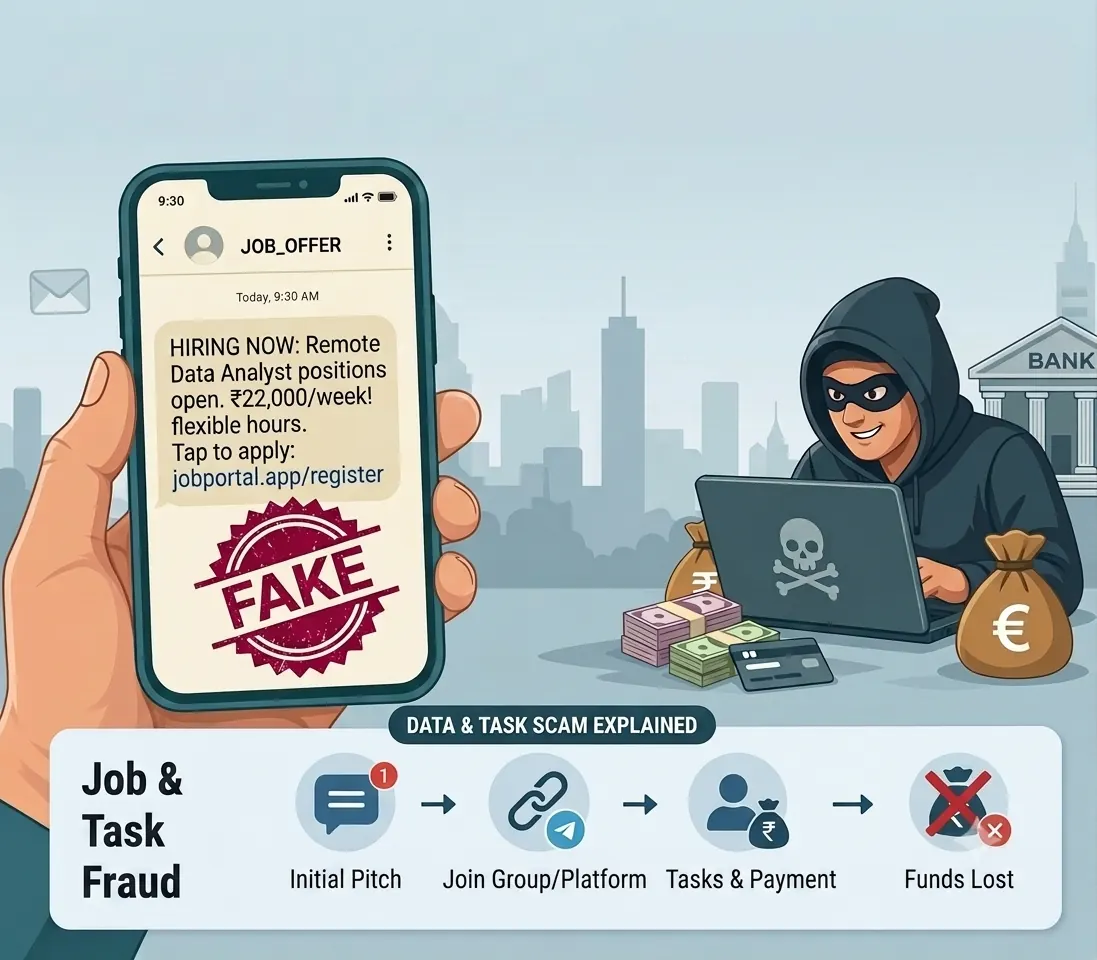
How it plays out
Six payouts that arrived, and one that did not
The message comes on WhatsApp from a number with a foreign code: part-time work, rating hotels and restaurants, ₹150 a task, paid daily. She rates five listings that evening and ₹750 arrives in her account before she goes to bed. It is a real credit from a real account.
She is added to a Telegram group of two hundred people. Trainers post the day's tasks; members post screenshots of withdrawals. Over four days she is paid six times, always on time, always exactly what was promised.
Then the tasks change. "Prepaid" tasks pay more, but the merchant requires the order value up front: deposit ₹2,000, complete the task, receive ₹2,800. The first one pays out. So does the second. The third is ₹15,000 and the payout does not arrive, because (the group admin explains) she completed the set out of order and the account is now on hold.
Fixing it costs ₹28,000, then a tax clearance of ₹40,000, then a final verification amount. Each one is presented as the last step before her balance is released. The balance is a number on a webpage; there was never an account behind it.
₹1,10,000 deposited over eleven days, against ₹4,300 ever received. The group was deleted the same evening she stopped paying.
A composite of the prepaid-task pattern as described in Indian cyber-cell advisories and reported victim accounts, including the initial genuine payouts, the group of planted withdrawals and the recovery-deposit stage. No real person or platform is depicted; the amounts are illustrative.
Where it could have stopped
The first prepaid task. Everything before it was a genuine job that paid; everything after it was her paying them. No employer in any industry requires the worker to fund the work, and that switch (from being paid to paying) is the entire scam in one step.
 High risk
What EnfoldAI does here
Scam checker
The recruiting message arrives on WhatsApp or Telegram rather than as an SMS, so paste it into EnfoldAI. The checker reads English and Hinglish, and it recognises the prepaid-task pitch as a scam at the point where nothing has been deposited yet.
Paste any message, link or app.
Auto-check with EnfoldAIHow this scam works
The order is the explanation. Find where your own experience stops in this list. That is how far along the script has run.
- Contact comes by WhatsApp or Telegram, often from a number abroad, offering part-time work: liking videos, rating hotels or restaurants, following accounts, simple data entry, packing pencils or diyas at home.
- The first tasks are trivial and are paid, usually a few hundred rupees, straight into your account. This is the only genuinely real part of the arrangement, and it is what the rest of the scam is buying.
- You are moved into a group where others post screenshots of large withdrawals, and "trainers" post the day's work. Most of those accounts belong to the operation.
- The tasks become "prepaid": to earn ₹2,800 you must first deposit ₹2,000, which is returned with the commission. The first one or two work, and the amounts are small enough to feel like a test.
- The deposits grow. Then a task fails on a technicality (you did them out of order, the account is "frozen for verification", tax must be cleared first) and the only way to recover what you have already put in is to deposit more.
- The balance you are chasing is a figure on a web page or in a chat. There is no account behind it and no withdrawal was ever going to be possible.
- Home-based packing versions invert it: you buy the raw material, then the finished work is rejected on quality grounds that were never going to be met.
- Some operations also ask you to receive money from strangers and forward it on, for a commission. That is money laundering, and it is what later gets an honest account frozen.
If it has already happened
In order, and the order matters. The first step is the one that can still get the money held, so it comes before everything else.
- Stop depositing. The recovery deposit is part of the design, and there is no amount that unlocks the account.
- Report on 1930 or at cybercrime.gov.in with the account numbers or UPI IDs you paid into, the group, and the numbers that recruited you.
- Tell your bank the beneficiary accounts were fraudulent so the dispute is on record, and ask what they can hold.
- Save the chat history and the group before you leave: screenshots, member list, payment instructions. It is usually deleted for you shortly afterwards.
- Ignore anyone who contacts you afterwards offering to recover the money for a fee. Recovery-fee approaches to people who have just lost money are a second scam run on the same list.
- If you were asked to receive money from others and forward it on, say so when you report. That is how honest accounts end up flagged as mule accounts, and it is much better raised by you than discovered later.
Job and task scams: common questions
The questions people actually ask about this one, answered in a line or two each.
They say one more deposit releases my money. Is that true?
The first payments were real. Why?
Someone offered to recover my money for a fee. Should I?
I received money and forwarded it. Am I in trouble?
Check before you trust
Paste any SMS, link or app and get a verdict before money moves. Auto-scan flags scam messages the moment they arrive.
Suspicious message? Check it free →