Digital arrest: there is no such thing
There is no such thing as a digital arrest in India. No police force, court, CBI, ED, TRAI or customs officer can arrest, detain or question anyone over a video call, and no lawful process requires you to stay on camera or to transfer money to prove your innocence. If a call is telling you that you are under arrest and must not hang up, the call is the crime. Hang up.
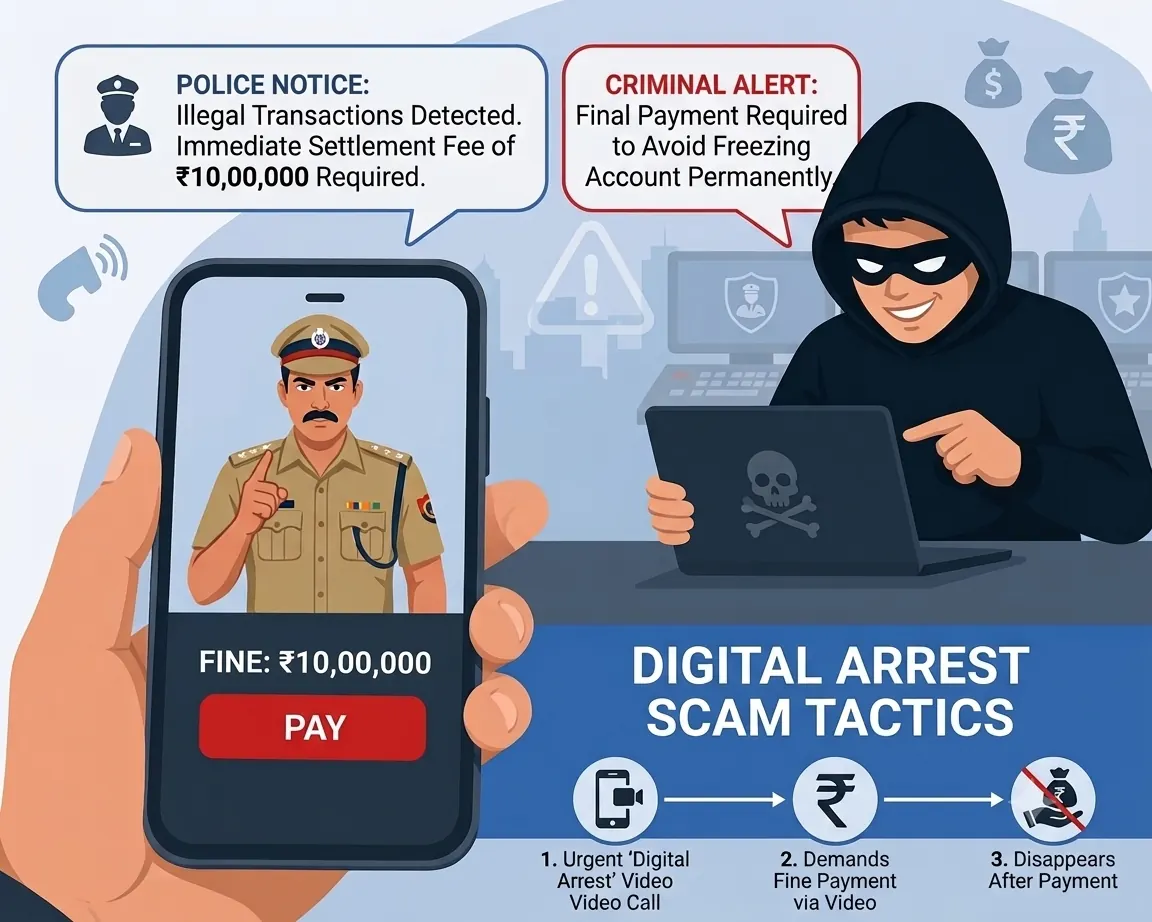
How it plays out
Twenty-six hours on a video call he was told not to end
It opens as a recorded message about a parcel: a courier in his name, intercepted, containing something illegal. Press 9 to speak to an officer. He presses 9 because he has not sent a parcel and wants to say so.
The officer is polite and grave, and transfers him to a video call. The room on the other side has a police emblem on the wall and a man in uniform behind a desk. A case number is read out. A warrant is held up to the camera. He is told he is under digital arrest, that the case is confidential, and that speaking to his family would make them accessories.
The call does not end. He keeps the phone with him when he eats and when he sleeps; the camera stays on. The officers change over. Each new one is a little more senior and a little more sympathetic than the last, and each explains the same procedure: his savings must be moved to a government verification account, held while the case is checked, and returned in full once he is cleared.
He transfers on the second day, in three amounts because his bank limits the first two. The call ends within the hour. His daughter finds out four days later, when the fixed deposit does not renew.
₹31,00,000 (most of a retirement) transferred over two days, to an account described as a government one.
A composite of the digital arrest pattern as described in I4C and state police advisories and in reported cases, including the parcel pretext, the shift-worked video call and the "verification account" demand. No real person or case is depicted; the amount is illustrative.
Where it could have stopped
The instruction not to tell his daughter. Nothing in Indian law forbids a person under investigation from speaking to their family or a lawyer, and no real case requires a video call to stay open. That single instruction is the scam identifying itself, and it comes early.
 High risk
What EnfoldAI does here
Scam checker
A digital arrest happens on a call, and no app can end a call for you. What EnfoldAI can do is take the parcel or SIM notice that sets it up (those arrive as messages) and mark it as a scam before the call comes. If a call is already running, anything you have been sent can be pasted into the checker while it runs.
Paste any message, link or app.
Auto-check with EnfoldAIHow this scam works
The order is the explanation. Find where your own experience stops in this list. That is how far along the script has run.
- It opens with an official-sounding reason: a parcel in your name containing drugs, a SIM registered to you used in a crime, a money-laundering case, a customs seizure. Often the first contact is an automated call.
- The call is handed to someone in uniform on video, in a room built to look like a police station. Fake ID cards, letterheads, seals, case numbers and arrest warrants are shown on camera.
- You are told you are under "digital arrest" and must stay on the call. You are told not to contact family or a lawyer because the case is confidential and they may be implicated.
- The isolation is the mechanism. It can run for hours or days, with shifts of "officers", so that you never speak to anyone who would tell you it is fake.
- A second, more senior "officer" is introduced partway through (sometimes named as CBI, ED or a judge on a video hearing) to make the process feel like it is escalating properly.
- The demand is framed as verification rather than payment: transfer your balance to a "safe" government account for checking, and it will be returned once you are cleared. It is not returned.
- If the first transfer goes through, the amounts grow and the reasons multiply: tax on the released funds, a clearance fee, a second case. This is a standard second stage, not a sign that the first payment was a mistake.
- Older people living alone are targeted heavily, and so is anyone whose savings sit in one place and can be moved in a single transfer.
If it has already happened
In order, and the order matters. The first step is the one that can still get the money held, so it comes before everything else.
- End the call. Nothing lawful is lost by hanging up on a real officer, and everything is lost by staying on with a fake one.
- Tell one person immediately: family, a neighbour, anyone. Breaking the isolation is what ends the script.
- If you transferred money, call your bank at once on the number on your debit card and ask them to raise a fraud dispute and hold the beneficiary.
- Report on 1930 or at cybercrime.gov.in as soon as you can, and in the first hour if at all possible.
- Keep the call records, the numbers, and screenshots of anything shown to you. Do not send further "verification" payments to recover the first one. That is a standard second stage.
- If you are helping an older relative afterwards, avoid framing it as their mistake. Shame is the reason most of these go unreported until the money is gone.
Digital arrest: common questions
The questions people actually ask about this one, answered in a line or two each.
Is digital arrest a real legal process in India?
Can I get in trouble for hanging up on them?
They said telling my family would make them accessories. Is that true?
I already transferred money. Is it too late?
How common is the digital arrest scam in India?
Check before you trust
Paste any SMS, link or app and get a verdict before money moves. Auto-scan flags scam messages the moment they arrive.
Suspicious message? Check it free →