Fake online shops: the price was the bait and the advance was the sale
A shop that exists only as a social-media page, prices its goods far below everyone else, and will accept payment only as a UPI transfer in advance is selling the advance, not the goods. Buy where you can pay on delivery or through a marketplace that holds the money until you have the item, and never pay a fee of any kind to receive a refund: a refund that costs money is the same shop taking a second payment.
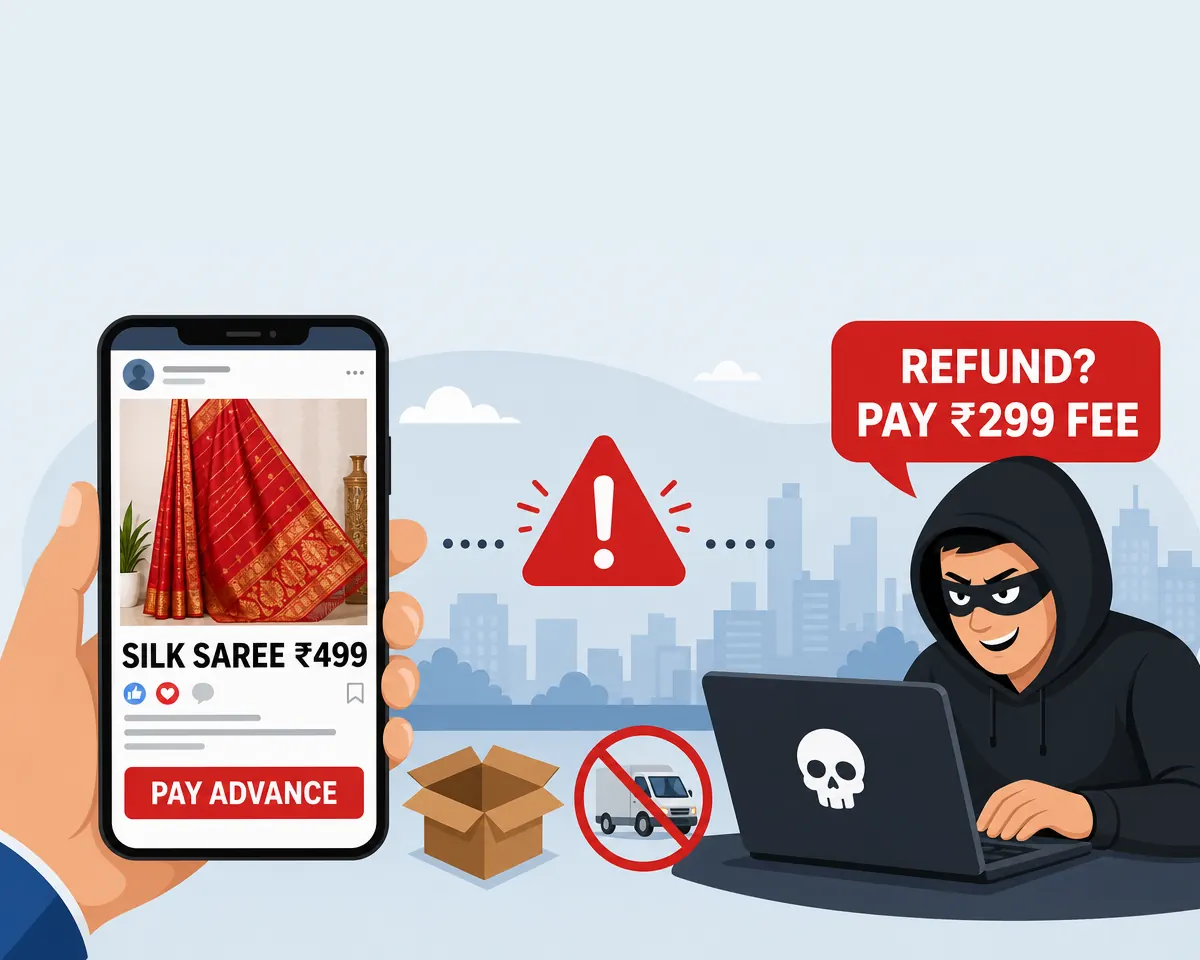
How it plays out
The Diwali saree at ₹499, the ₹1,299 advance and the ₹499 insurance
The page has forty thousand followers, photographs of silk sarees that would cost ₹4,000 in a shop, and a Diwali sale at ₹499 each. She messages, picks three, and is sent a UPI ID for ₹1,299 with delivery "in four to five days". Cash on delivery is not available during the sale.
A tracking number arrives by WhatsApp. On day six the page messages: the parcel is held at the courier's hub because the order value exceeds the free-delivery limit, and ₹499 transit insurance must be paid for release, refundable on delivery. She pays, because the sarees are already on their way.
On day nine the page is gone. The tracking number was never valid on any courier's site. The photographs belonged to a boutique in another city that had been complaining about them for months.
A week later a "customer care" number she finds by searching the shop's name offers a full refund, which needs a ₹49 verification payment and the OTP that follows. That OTP is for ₹24,999.
₹1,798 paid for sarees that did not exist, and a further ₹24,999 to the "refund desk" that found her afterwards.
A composite of the fake online-shop pattern as described in consumer-affairs and police advisories and in reported cases, including the advance-payment, release-fee and refund-desk stages. No real person, shop or case is depicted; the amounts are illustrative.
Where it could have stopped
UPI in advance as the only option. A seller with stock to sell can take cash on delivery or a marketplace payment held until delivery; a seller who will only be paid up front, into a personal UPI ID, has priced the goods to be ordered and not to be sent.
 Suspicious
What EnfoldAI does here
Scam checker
The shop's payment message, the courier "hold" message and the refund-desk pitch can each be pasted into EnfoldAI. The checker flags a tracking link that goes nowhere real and a refund that asks for money or an OTP, which are the two points where this scam takes its second and third payments.
Paste any message, link or app.
Auto-check with EnfoldAIHow this scam works
The order is the explanation. Find where your own experience stops in this list. That is how far along the script has run.
- The shop is a social-media page or a one-page website, with product photographs taken from real boutiques and brands, a large follower count that was bought, and prices well below the market during a festival "sale".
- Orders are taken over chat and paid in advance by UPI, to a personal ID or a name that does not match the shop. Cash on delivery is "unavailable during the offer".
- Something arrives, or nothing does. If something does, it is a cheap substitute for the photograph, and the return process needs a fee. If nothing does, a tracking number buys time, and then a release fee, a customs or insurance charge, or a re-delivery fee buys more.
- The page disappears when the complaints outnumber the orders, and reappears under a new name with the same photographs.
- The second scam follows the first. Searching the shop's name, or any shop's customer care number, turns up fake helplines that offer a refund in exchange for a small verification payment and an OTP, or ask you to install a screen-sharing app to "process" it. That is where the large loss usually happens.
- The cash-on-delivery version works in reverse: a parcel you did not order arrives with a COD amount, or a call asks you to share an OTP to "cancel" an order you did not place.
If it has already happened
In order, and the order matters. The first step is the one that can still get the money held, so it comes before everything else.
- Stop paying. No release fee, insurance charge or verification payment produces the parcel or the refund.
- If the payment was recent, call your bank on the number on your card and ask it to raise a dispute and flag the UPI ID or account you paid; raise the same dispute inside the UPI app you paid from.
- Report on 1930 or at cybercrime.gov.in with the page, the UPI ID, the chat and the tracking number. For an undelivered order from a seller that does exist, the National Consumer Helpline on 1915 and its portal take the grievance.
- Report the page to the platform it was on, with the chat and the payment screenshot, so it is taken down before the next festival.
- Do not call a customer-care number you found by searching. Any refund offer that needs a payment, an OTP or a screen-sharing app is a second scam working the same list.
- Keep every screenshot: the listing, the chat, the payment confirmation, the tracking number. They are the complaint.
Fake online shops: common questions
The questions people actually ask about this one, answered in a line or two each.
A refund desk says I must pay a small fee to process my refund. Is that genuine?
How do I buy safely from an Instagram or Facebook shop?
Where do I complain about an undelivered online order?
Can I get an advance UPI payment back?
Check before you trust
Paste any SMS, link or app and get a verdict before money moves. Auto-scan flags scam messages the moment they arrive.
Suspicious message? Check it free →