Fake recovery agents: the promise to get your money back is the second scam
Money lost to cyber fraud in India comes back through your bank, the 1930 or cybercrime.gov.in complaint, and the police or court order that releases a held amount, and none of them charges you a fee. An agent, "ethical hacker" or "cyber cell officer" who contacts you, or whom you find online, offering recovery for an advance charge is running a second scam on the people the first one robbed.
How it plays out
The ₹1.8 lakh loss, the public post, and the recovery team at 80%
After losing ₹1.8 lakh to a task scam, a software tester does everything right: she calls her bank, files on 1930 the same evening and gets an acknowledgement number. Then, angry, she posts the whole story on social media, with a screenshot of the complaint, to warn others.
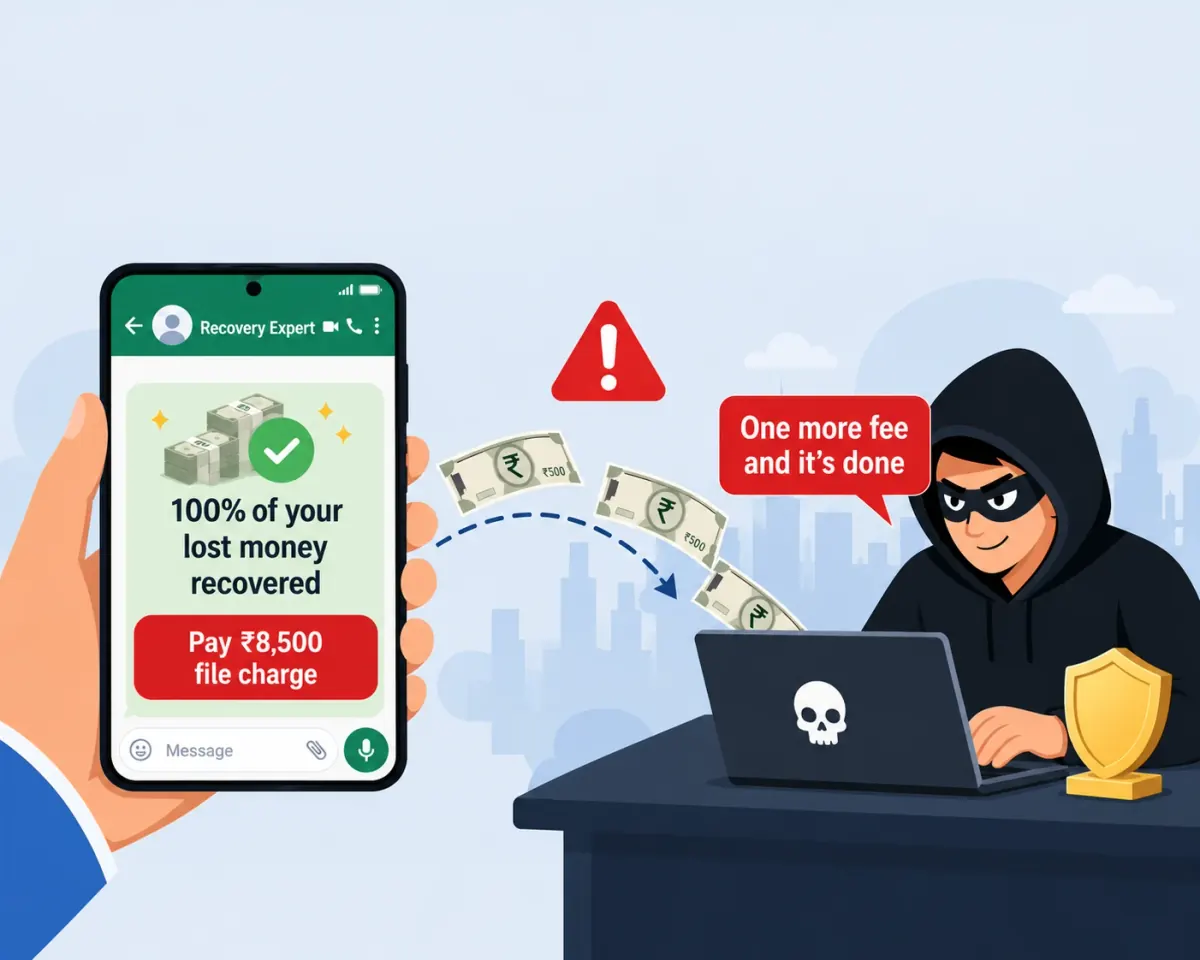
Two days later a "cyber recovery team" messages her on WhatsApp. They quote her complaint number, know the amount and the scam, and say they work with the cyber cell. Their screen shows her case at "recovery 80%". Release needs a file charge of ₹8,500.
After the file charge comes a court fee of ₹15,000, then TDS on the recovered amount, ₹22,000, each with a document that looks like an order. A man in a uniform on a video call tells her the money will be credited within 48 hours of the last payment.
No money arrives. Her real complaint, with her bank and the police, was open the whole time, and the investigating officer had never heard of a recovery team.
₹45,500 paid to a "recovery team" to get back ₹1.8 lakh it never had, on top of the original loss.
A composite of the fake recovery-agent pattern as seen in incidents reported to EnfoldAI and described in Indian police advisories, including the public complaint as the lead, the progress screen and the escalating fees. No real person or case is depicted; the amounts are illustrative.
Where it could have stopped
The first message. Nobody genuine contacts a fraud victim offering to recover money for a fee; the police and the bank deal with you through the complaint itself, and released money arrives in your account without a charge. The complaint number in her post was all the "recovery team" needed to sound official.
 High risk
What EnfoldAI does here
Scam checker
The recovery offer can be pasted into EnfoldAI before anything is paid. The checker flags a refund or recovery that needs a fee first, which is the whole of this scam, however official the documents attached to it look.
Paste any message, link or app.
Auto-check with EnfoldAIHow this scam works
The order is the explanation. Find where your own experience stops in this list. That is how far along the script has run.
- The list comes first. People who have just lost money search for how to recover it, post about it, comment on news stories and complaint forums, and sometimes publish their complaint numbers. The original fraudsters also keep their victims' numbers, and sell them.
- The offer arrives, or is found: a "recovery agency", "ethical hacker", "fund recovery lawyer", "cyber cell officer" or "RBI recovery desk", advertised in search results and on social media or calling you directly. They know your amount, your bank and sometimes your complaint number.
- The proof: a dashboard showing your case at 70% or 80%, a letter with a government-style seal, an officer in uniform on a video call, a promised percentage back.
- The fees: registration, file charge, court fee, lawyer's fee, TDS, an NOC, a "hacker fee" to trace the account. As with lottery scams, each payment brings the next, and the money never comes.
- A variant targets people whose bank accounts are frozen, offering to "remove the lien" or "close the complaint" for a fee. A freeze is lifted by the bank on the investigating officer's word or a court order, not by an agent.
- Nobody can "hack" money back. Money held after a complaint is released by the bank on a police or court order. If an officer asks for an indemnity bond, you buy the stamp paper yourself; nothing is ever paid to an agent or into a personal UPI ID.
- A lawyer you engage to go to court is a different thing, but an advocate in India may not charge a share of what is recovered. A "recovery service" that takes a percentage is not a law practice.
If it has already happened
In order, and the order matters. The first step is the one that can still get the money held, so it comes before everything else.
- Stop paying. A file charge, court fee, TDS, NOC or "hacker fee" is never the last one, and no genuine process charges any of them.
- If you paid the agent, call your bank on the number on your card and ask for a fraud dispute on those transfers as well.
- Report it on 1930 or at cybercrime.gov.in as a new complaint, and quote your original complaint number so the two are linked.
- Follow your original complaint only through cybercrime.gov.in, your bank and the police station handling it. The acknowledgement number is enough to check its status; nobody needs to be paid to see it.
- If your complaint froze money, the refund guide explains how it is released, through the bank and the investigating officer.
- Take down public posts that show your complaint number, amount or bank. Those details are how the next caller sounds official.
Fake recovery agents: common questions
The questions people actually ask about this one, answered in a line or two each.
Can a recovery agent or hacker get my scammed money back?
Fraud ka paisa wapas kaise milega?
Someone from the "cyber cell" says my money is recovered but asks for a fee. Is it genuine?
Is there a cyber fraud money recovery helpline number?
Check before you trust
Paste any SMS, link or app and get a verdict before money moves. Auto-scan flags scam messages the moment they arrive.
Suspicious message? Check it free →