Investment scams: the profit on the screen was never money
No registered broker in India takes money through a WhatsApp or Telegram group, and no genuine trading account asks you to pay a tax, a commission or a clearance fee before it lets you withdraw your own balance. If the profit is on a screen inside an app you were sent a link to, and withdrawing it costs money, the profit is a number and the fee is the scam.
How it plays out
The ₹2,40,000 profit that cost ₹6,80,000 to withdraw
He is added to a WhatsApp group by a number he does not know. Two hundred members, a daily list of stock calls from a "mentor" with a professional headshot, and screenshots of members thanking him for the morning's gains. The calls are good for a fortnight; he checks them against the real market and they are right more often than not.
Then the mentor offers the group an institutional account: an app, sent as a link, that trades in blocks and gets IPO allotments at a discount the public never sees. He puts in ₹50,000 to test it. Within three weeks the app shows a balance of ₹2,90,000, and a withdrawal of ₹10,000 lands in his bank the same afternoon.
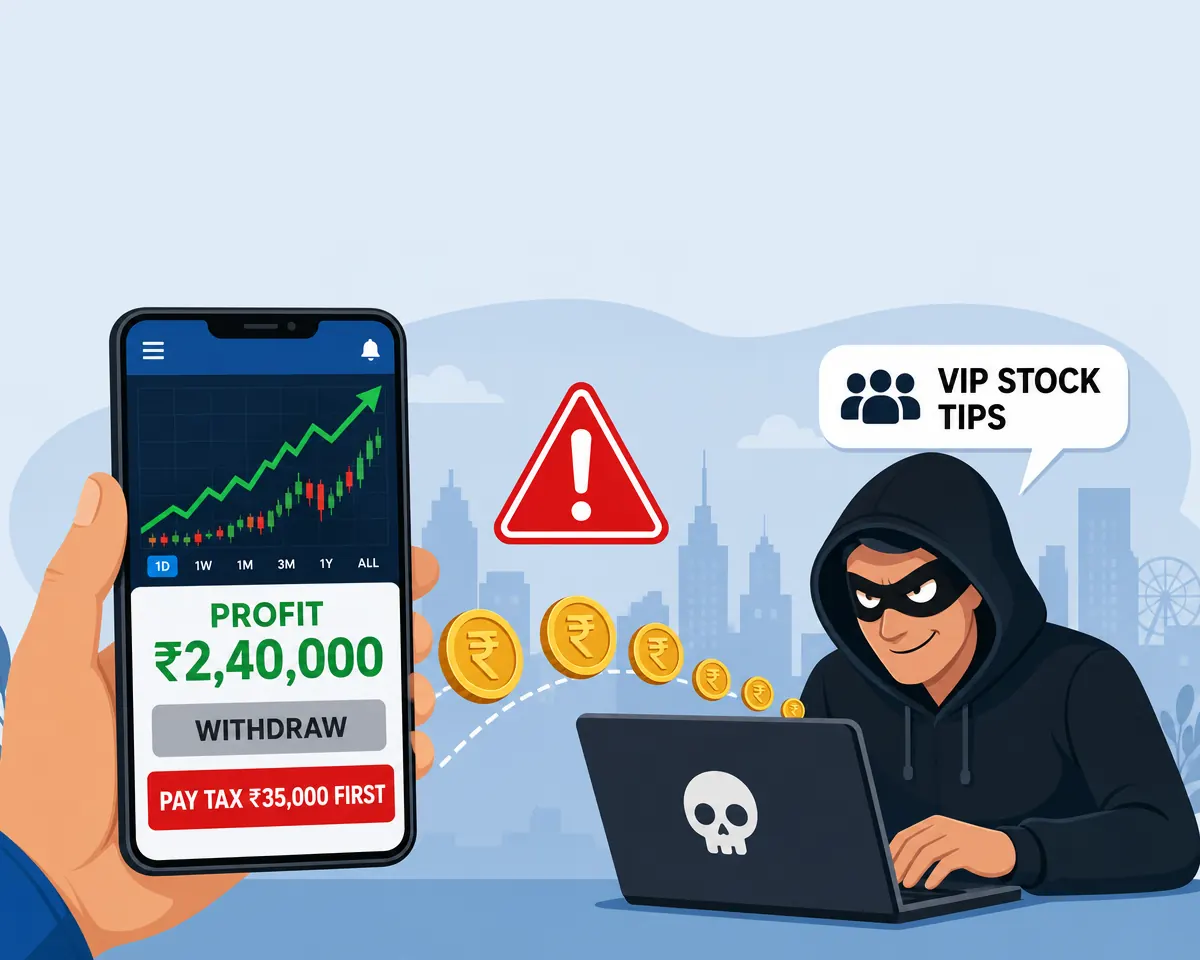
He puts in ₹3,00,000 more. The balance climbs past ₹9,00,000 on an IPO allotment, and he asks to withdraw it. The app shows a hold: income tax of 20 per cent must be paid before release, separately, to a given account, because the profit came through an institutional channel. He pays ₹1,80,000. The hold changes to an anti-money-laundering review, which costs a further ₹1,50,000 to clear.
The balance was never money. The app displayed what a server told it to display, the stock calls were copied from public recommendations with the losers deleted, and the members thanking the mentor were the operation. The one withdrawal that worked was the cost of everything that followed.
₹6,80,000 deposited over seven weeks, against ₹10,000 ever withdrawn. The group was deleted the day after he stopped paying.
A composite of the fake trading-app pattern as described in SEBI's May 2025 caution to investors, I4C advisories and reported cases: the WhatsApp or Telegram "VIP" group, the institutional-account app, the single successful withdrawal and the tax-before-release demand. No real person, app or case is depicted; the amounts are illustrative.
Where it could have stopped
The app arriving as a link in a chat. A SEBI-registered broker's app is on the Play Store under the broker's own name, and SEBI's own register lists who is registered. An "institutional" app that can only be reached through the mentor's link is an app the mentor controls, and so is every number it shows.
 High risk
What EnfoldAI does here
Scam checker
The invitation, the app link and the "pay tax to withdraw" message all arrive as messages, and each one can be pasted into EnfoldAI before any money moves. The checker recognises the VIP-group pitch and the pay-to-withdraw demand as the scam they are, at the stage where the only thing you have given them is your number.
Paste any message, link or app.
Auto-check with EnfoldAIHow this scam works
The order is the explanation. Find where your own experience stops in this list. That is how far along the script has run.
- It starts with an invitation you did not ask for: a WhatsApp or Telegram group, a social-media ad for a free trading course, or a dating-app match who happens to trade. The group has a "mentor" or "professor" and hundreds of members, most of whom belong to the operation.
- The early calls are real stocks and often genuinely rise, because they are copied from public recommendations and the ones that fell are quietly deleted. Members post gratitude and screenshots. This stage costs you nothing and is meant to.
- You are offered something the public cannot get: an institutional account, block trades, IPO allotments at a discount, guaranteed daily returns. It comes as a link to an app or a website, never as a Play Store listing under a registered broker's name.
- The app shows a balance that rises whatever the market does, and a small early withdrawal is paid promptly from the operation's own funds. That one payment is what makes the next, larger deposit feel safe.
- When you try to withdraw a large amount, the account is put on hold: income tax on the profit, a commission, a "credit score" top-up, an anti-money-laundering clearance. Each has to be paid separately, up front, to a different account, and each is described as the last step.
- The hold never clears. The balance was a number on a screen that a server controlled, and the deposits went to mule accounts that are emptied within hours.
- Afterwards, a "recovery agent" or "cyber police officer" may contact you offering to get the money back for a fee. That is the same operation, or one that bought the list.
If it has already happened
In order, and the order matters. The first step is the one that can still get the money held, so it comes before everything else.
- Stop depositing. Every fee the app asks for is the scam continuing, and there is no amount that releases a balance that was never there.
- If the last deposit was recent, call your bank on the number on your debit card and ask it to raise a fraud dispute on the transfers and flag the beneficiary accounts. The newest transfer is the one most likely to still be held.
- Report on 1930 or at cybercrime.gov.in with every account number, UPI ID, group link, app link and phone number you have. Speed matters here as it does everywhere.
- If a real listed company or a real SEBI-registered broker's name was used, say so in the complaint and report it to SEBI through its SCORES portal as well; impersonation of a registered intermediary is something SEBI acts on.
- Save everything before you leave the group: the member list, the mentor's profile, the app's screens, the payment instructions. It is usually deleted for you within a day.
- Ignore anyone who contacts you afterwards offering to recover the money for a fee, however official they sound. No private agent and no police officer recovers money for a payment.
Investment and trading scams: common questions
The questions people actually ask about this one, answered in a line or two each.
The app says I must pay tax before I can withdraw. Is that normal?
My first withdrawal worked. Doesn't that prove the app is genuine?
How do I check whether a trading app or adviser is genuine?
Can I get money back from a trading scam?
Is a guaranteed IPO allotment at a discount possible?
Check before you trust
Paste any SMS, link or app and get a verdict before money moves. Auto-scan flags scam messages the moment they arrive.
Suspicious message? Check it free →