Lottery and prize scams: a prize that costs money is not a prize
You cannot win a lottery or lucky draw you never entered, and a genuine prize never needs a fee first. Tax on a real prize is deducted at source by whoever pays it, never collected from the winner in advance. A WhatsApp message, call or scratch card announcing a "KBC lottery", a SIM-number draw or a car is the opening of a scam that charges one fee after another until you stop paying.
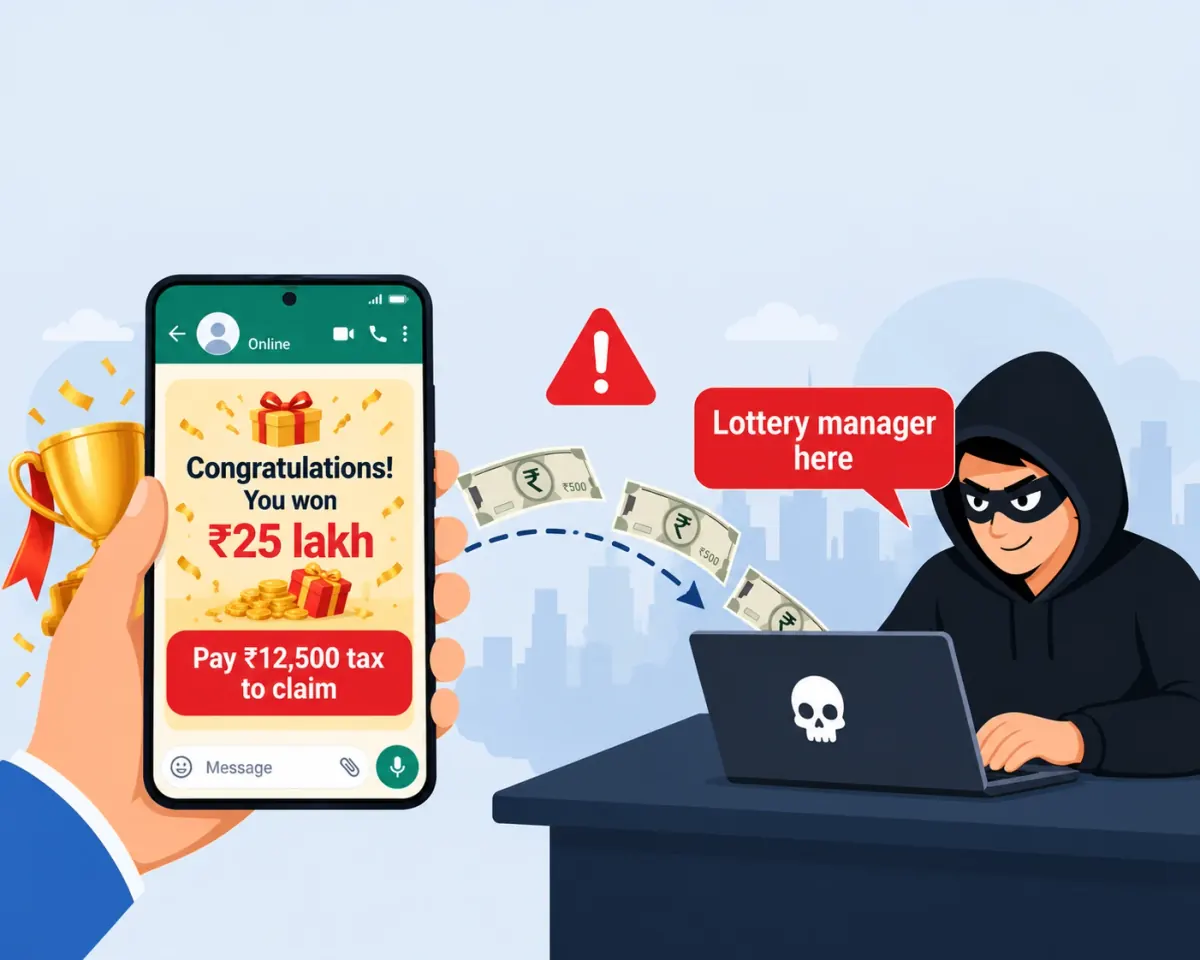
How it plays out
The ₹25 lakh lottery that was 99% complete
A WhatsApp message arrives with a picture of a famous TV quiz host and a gold certificate: her mobile number has won ₹25 lakh in a lucky draw run with a telecom company, and she should call the "lottery manager" on the number given. She does not remember entering anything, and says so. The manager explains that the draw is of SIM numbers, so nobody enters.
Registration is ₹12,500. A week later, GST on the prize is ₹38,000. Then an "RBI clearance certificate" on stamp paper, with a seal, is ₹65,000. Each payment brings a voice note thanking her and a new document, and each document brings the money closer.
At "99% complete", a final NOC charge of ₹45,000 is all that stands between her and the prize. She has borrowed from her sister for the last two payments. Her son, home for the weekend, reads the certificate and finds the RBI seal on it spelled wrong.
The manager's number stops answering that evening. A month later a different number calls from a "cyber cell recovery desk", offering to get her ₹1,15,500 back for a file charge.
₹1,15,500 paid in three fees for a prize that did not exist, half of it borrowed, and a "recovery" call the following month.
A composite of the lottery and prize-fee pattern as described in RBI and Indian police advisories and in incidents reported to EnfoldAI, including the "lottery manager", the escalating fees on stamp paper and the follow-up recovery call. No real person, company, TV programme or case is depicted; the amounts are illustrative.
Where it could have stopped
The first fee. A prize that has to be paid for before it is paid out is the fee itself, and every later charge, whether GST, RBI clearance or an NOC, is the same request under a different name. Refusing the first ₹12,500 was the only point at which refusing cost nothing.
 High risk
What EnfoldAI does here
Scam checker
The winner message, the "certificate" and each fee demand can be pasted into EnfoldAI. The checker recognises the prize-for-a-fee script and says so before the first payment, which is the easiest one to refuse.
Paste any message, link or app.
Auto-check with EnfoldAIHow this scam works
The order is the explanation. Find where your own experience stops in this list. That is how far along the script has run.
- It starts with a win you did not enter: a WhatsApp message or call about a KBC or telecom "lucky draw", an email about an international lottery, a scratch card that arrives by post after an online order, or a "lucky customer" SMS. The prize is large and specific: ₹25 lakh, a car, a new phone.
- The proof is theatre: a certificate with a famous face and official-looking seals, a "lottery manager" on WhatsApp with a TV logo as his photo, voice notes, a stamp-paper agreement, sometimes a fake RBI or income-tax letter.
- Then the fees: registration, GST, TDS, RBI clearance, an NOC, courier, insurance, account activation, an anti-money-laundering certificate. Each fee is explained, each is "refundable with the prize", and each payment produces the next.
- The progress bar is the hook. "99% complete" arrives at the point where you have paid too much to walk away, and people borrow to make the last payment.
- The same script is run with other bait: an old ₹1 or ₹5 coin a buyer will pay lakhs for, after a registration fee, or "funds" from abroad or from the government that need a release charge. RBI has said it does not deal in old coins or notes and never charges fees of any sort.
- Afterwards, a "recovery desk" or "cyber cell officer" calls offering to return what you lost, for a fee. That is the same operation, or one that bought the list.
If it has already happened
In order, and the order matters. The first step is the one that can still get the money held, so it comes before everything else.
- Stop paying. No further fee, whatever it is called, produces the prize.
- If you paid recently, call your bank on the number on your card or passbook, ask for a fraud dispute on the transfers and for the receiving accounts to be flagged, and raise it in your UPI app as well.
- Report on 1930 or at cybercrime.gov.in with the numbers, the UPI IDs or accounts you paid, the certificates and the chat.
- Block and report the number in WhatsApp. Do not call a "lottery manager", "KBC head office" or "helpline" number you find by searching; those numbers are published by the same people.
- Expect a call offering to recover your money for a fee. Nobody genuine recovers money for a fee; that call is the next stage of the same scam.
Lottery and prize scams: common questions
The questions people actually ask about this one, answered in a line or two each.
Is the KBC lottery real or fake?
KBC lottery manager ka WhatsApp number kya hai?
Do I have to pay tax before I receive prize money?
A buyer will pay lakhs for my old coin but wants a registration fee. Is it real?
Check before you trust
Paste any SMS, link or app and get a verdict before money moves. Auto-scan flags scam messages the moment they arrive.
Suspicious message? Check it free →